Some trafficking survivors arrive at Bakhita St. Louis Empowerment Network in Nigeria carrying little more than a plastic bag. Some cannot initially remember where they came from, while others provide false names or information before staff has earned their trust.
Helping them rebuild their lives can involve shelter, medical treatment, counseling, vocational training, family tracing, and support in establishing a business. Delivering that care requires coordination across institutions, but it also depends on relationships that are difficult to create through a short-term intervention.
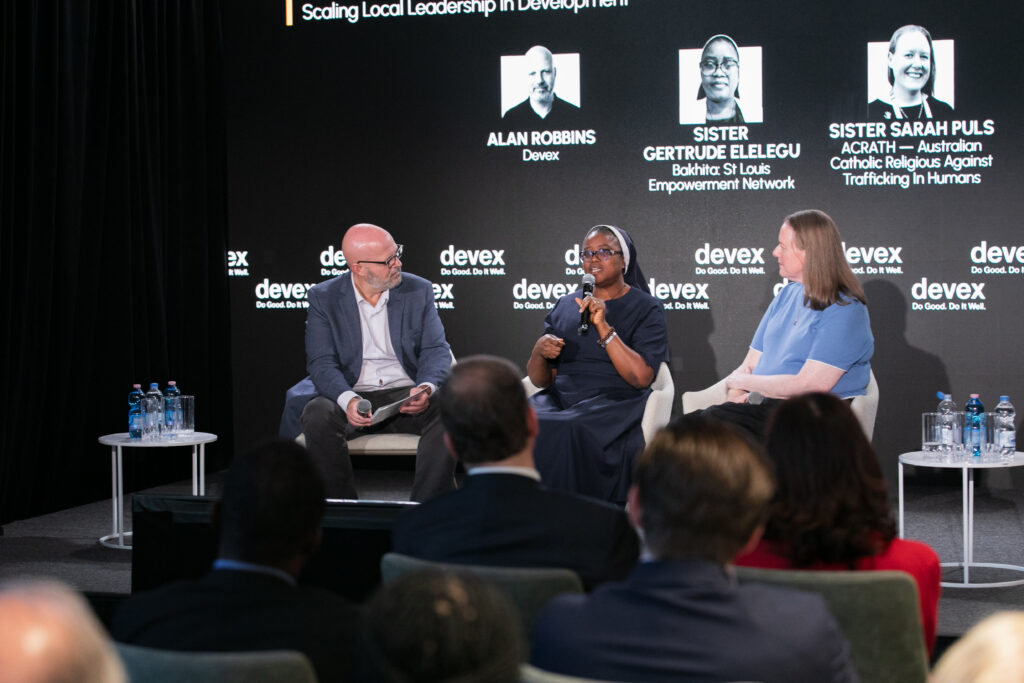
At Devex Impact House @ UNGA81, Sister Sarah Puls, national executive officer of Australian Catholic Religious Against Trafficking in Humans, or ACRATH, and Sister Gertrude Elelegu of Bakhita St. Louis Empowerment Network joined Devex co-founder and Executive Vice President Alan Robbins to discuss the role sisters can play in the development agenda such as combating human trafficking. Their work is connected through The Conrad N. Hilton Foundation’s Catholic Sisters Initiative.
The speakers described how sisters’ long-term presence within communities can help them build trust with survivors and connect them with wider systems of support.
Here are the takeaways.
Bakhita’s shelter can accommodate around 30 trafficking survivors. Staff refers to the women they support as “treasures.”
“We decided to use that name — Treasures — to make them know that they are valued, they are respected, they are still treasured,” Elelegu said.
Women receive accommodation, food, clothing, medical care, and counseling. When ready, they choose vocational training based on their interests and abilities. Bakhita then helps them establish businesses and settle where they feel comfortable, since stigma may make some reluctant to return home.
“With the love we show them, with the care, with the way they experience us … we earn that trust,” Elelegu said.
Bakhita also brings therapists into the shelter, allowing women to receive mental health support in familiar surroundings.
Bakhita belongs to the Nigerian Conference of Women Religious Against Trafficking, part of the international Talitha Kum network. It coordinates with the International Organization for Migration when survivors are repatriated, particularly minors, pregnant women, and women traveling with children.
Nigeria’s National Agency for the Prohibition of Trafficking in Persons documents cases and joins community awareness activities, while state task forces provide security. These partnerships connect Bakhita’s survivor support and community relationships with national and international institutions.
In Australia, ACRATH works with government agencies, nonprofits, schools, and health institutions, including training clinical staff to recognize and respond to trafficking. Across Pacific island countries, it supports sisters and their partners to identify trafficking patterns that remain poorly understood.
Sisters can also bring “particular relationships of trust” to partnerships with other institutions, Puls said. Their work is grounded in the conviction that exploitation does not diminish a survivor’s humanity.
“Every human being has dignity,” she said. “That dignity is not impacted by what they go through.”
For funders, the central lesson is that expertise already exists in the communities they want to support.
“Aid money comes and goes. Aid organizations sometimes come and go. But people who are in the communities are there,” Puls said.
Those local groups understand how trafficking manifests, which institutions people trust, and what survivors need. Puls urged funders to listen to communities before deciding what kind of project to support.
“The people on the ground already know what the needs are,” she said. “And they already have ways of finding solutions.”
Watch the full conversation with Sister Sarah Puls, national executive officer of ACRATH, and Sister Gertrude Elelegu of Bakhita St. Louis Empowerment Network at Devex Impact House @ UNGA81. Via YouTube.