On Tuesday, October 6, hundreds of leaders gathered at The Beverly Hilton for the 2026 Hilton Humanitarian Symposium and Prize Ceremony, culminating in the presentation of the 2026 Hilton Humanitarian Prize to Last Mile Health. This year’s theme, “Navigating Complexity,” shaped a day of conversations about conflict, storytelling, safe water, health and the role of connection in addressing complex challenges. Speakers included emcee Soledad O’Brien, Amanda Ripley, Jim Yong Kim, M.D., Ph.D., Raj Panjabi, M.D., Scott Harrison, Shabana Basij-Rasikh, Yusra Mardini, and many more.
Linda Hilton, Conrad N. Hilton Foundation board chair, opened the symposium reflecting on her grandfather Conrad Hilton’s vision: “My grandfather, Conrad Hilton, believed deeply that we are all connected. He believed we are obliged to empathize with those facing hardship, and to provide care and support. He even wrote this in his last will and testament: ‘Love one another, for that is the whole law.’ For more than three decades, the Hilton Humanitarian Prize has honored organizations, many of you, who are in this room, that answer his call with courage, compassion, and practical solutions.”
Peter Laugharn, Hilton Foundation president and CEO, reflected on what it means to navigate complexity: “Today’s event will focus on ‘navigating complexity.’ There can be a temptation in complex and turbulent times to assume change will somehow emerge. To, perhaps, retreat deeper into our own lives. To look to someone in business or politics to solve our problems for us. Today, you will hear from folks who have rejected this impulse — who have instead embraced, as Soledad called it, ‘a selfless curiosity.'”
In her remarks, “Breaking the Spell of High Conflict,” Amanda Ripley, Award-winning Author, Washington Post Columnist, and Co-Founder of Good Conflict, explored what fuels high conflict, how an “us vs. them” mentality takes hold, and the practical, often counterintuitive ways we can navigate conflict more effectively. “Conflict is not the problem. You need conflict, right? To challenge each other, to be pushed. That is how we get better as individuals, as organizations, as families, as countries.”
A panel on “Telling Human Stories in a World Shaped by Conflict” explored the responsibilities that come with telling deeply personal stories. The panel was moderated by Stephanie Sinclair, Pulitzer Prize-winning Photojournalist and President and CEO of Too Young to Wed, in discussion with Marcel Mettelsiefen, Filmmaker and Founder, Duskwater Films, Tim Davis, Former U.S. Ambassador to the State of Qatar and MAG US Board Chair, and Yusra Mardini, Olympian, Goodwill Ambassador for UNHCR, and Founder of the Yusra Mardini Foundation. Mardini shared her own experience of storytelling through film: “When you’re telling a story about a refugee, when you’re telling a story about something that important in life, you have the responsibility of telling the stories of millions of people, not just mine, not just my sisters… I think that’s the power of filmmaking.”
In remarks titled “Dare to Dream,” Shabana Basij-Rasikh, Co-Founder and President, School of Leadership, Afghanistan (SOLA), asked, “How do we dare to dream? You open more doors. You knock harder on the closed ones, and when they open, you walk confidently through. You commit to building a movement. Building coalitions. You commit to the notion that no one can do it alone. One voice is strong. 100 voices are stronger. One organization is strong. 100 organizations are stronger.”
Scott Harrison, Founder and CEO, charity: water, then moderated a panel discussion entitled “What Keeps Water Flowing” with Catherine Sellman, Founder and CEO, Wildland Urban Interface Foundation, Kate Cincotta, Co-Founder and Executive Director, Saha Global, and Sylvester Adjapong, Director of International Operations, NUMA. Adjapong shared, “We need to measure success [just] beyond the cutting of the ribbon to ask ourselves if we come back six years from now, will that same tap be working? Will safe water be flowing?”
Next, Jim Yong Kim, M.D., Ph.D., Co-Founder, Partners In Health and Chancellor, The University of Global Health Equity, sat down with Raj Panjabi, M.D, Last Mile Health Co-Founder and Flagship Pioneering Senior Partner, to discuss Dr. Panjabi’s upcoming book “Safer: Turning Fear Into Action and Crisis Into Community.” Dr. Panjabi said, “The central message… is that it turns out the answer to the question when systems fail us – people who are supposed to keep us safe fail us – what can we do for one another?… The answer is that the greatest protection each of us have is not isolation, but connection.”
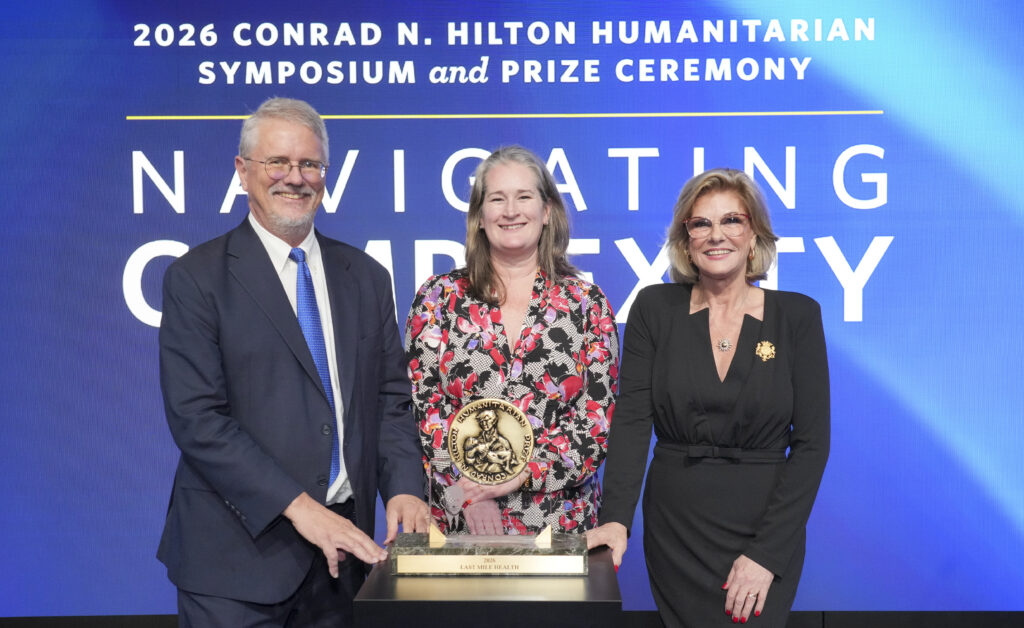
Later that afternoon, the focus shifted to the 2026 Hilton Humanitarian Prize Ceremony honoring Last Mile Health. Senior Director of the Hilton Humanitarian Prize Maggie Miller presented the award to Last Mile Health CEO Lisha McCormick, who accepted the award on behalf of the organization. Last Mile Health was selected for demonstrating how strong community health systems can expand access to care at scale, reaching people who have historically been beyond the reach of healthcare. In her acceptance remarks, McCormick said: “I’m honored to stand here today on behalf of Last Mile Health and the thousands of community health workers we serve. Last Mile Health exists because of an enduring problem. Illness is universal, and access to healthcare is not.”
Following the award presentation, James Nardella, President and Chief Program Officer, Last Mile Health, sat down with Lia Tadesse Gebremedhin, M.D., MHA, Executive Director, Harvard Ministerial Leadership Program, Professor of the Practice of Public Health, Harvard T.H. Chan School of Public Health, and Former Minister of Health, Federal Ministry of Health Ethiopia, for a discussion titled “Reaching the Last Mile.” Nardella remarked, “I think about these national [government health] programs… and what Last Mile Health does is really work person to person. As much as we describe these as a program or even systems change, it starts human by human… It makes quite a difference to have a trusted companion.”
The afternoon ended with a special musical performance by Liberian-born, Tennessee-based artist Mon Rovîa, who has built a global following through music that blends folk, soul, and deeply personal storytelling. Closing the day, he performed a selection of songs that reflected themes of resilience, belonging, and hope, offering a memorable conclusion to the 2026 Hilton Humanitarian Symposium and Prize Ceremony.