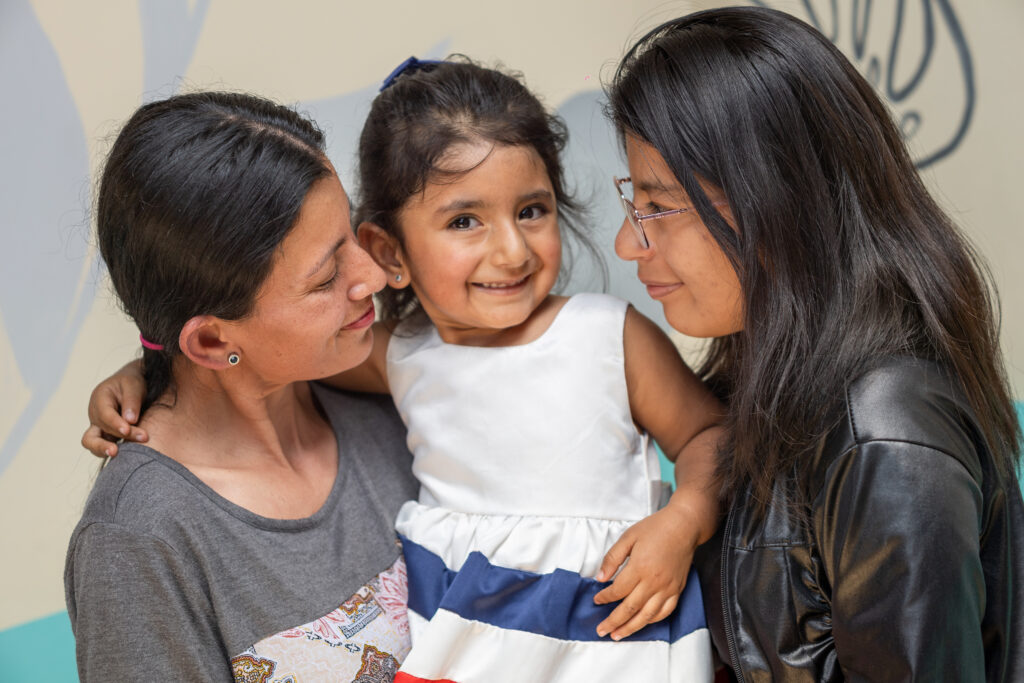
Ana Edilma García de la Cruz, 40, poses with her daughters Isabella, 4 and Sheyla Figueroa, 21 at a FUDELA early learning center in Quito, Ecuador. (Soledad Rosales + Alejo Reinoso/Conrad N. Hilton Foundation)
On June 20, the Conrad N. Hilton Foundation and partners around the world will honor individuals, families and children who have been forced to flee their homes. World Refugee Day presents us with a reminder that challenges for refugee and host communities remain steep, but that reasons for hope and optimism are even stronger.
Ongoing challenges for refugees in 2026:
Despite a slight decrease in the past year, the number of displaced people globally remains incredibly high, with nearly 118 million people — including more than 41 million refugees — displaced due to persecution, conflict, natural disasters and other causes. In countries where the Hilton Foundation operates, like Uganda, Ethiopia, Colombia and Ecuador, refugees’ situations have become more and more protracted, with the average length of displacement now approximately 20 years.
Funding shortfalls stemming from massive cuts to Official Development Assistance (ODA) and overall humanitarian assistance are disproportionately affecting refugee communities. We are seeing the cascading effects of these aid cuts in the countries where our Refugees Initiative partners are working, including increased stress on health, education and food systems.
In many contexts, refugee families and children are not able to thrive due to economic disadvantages. Poverty rates remain significantly higher for refugees than the general population—one of the single greatest factors limiting their wellbeing. Refugees face increased barriers to employment and livelihood opportunities due to discrimination, lack of documentation and other factors; and when they are unable to provide for their children’s basic needs during the critical early childhood window, refugee children face adverse health and development consequences for the rest of their lives.
Despite these challenges, many reasons for hope remain:
Amid drastic funding cuts over the past two years, the voices and leadership of refugee communities and advocates have been a steady and encouraging presence. Refugee leaders are not just standing by while conflict expands and resources shrink, but instead speaking up louder than ever to ensure that decisions, policies, and programs that affect displaced people are inclusive and beneficial to refugee and host communities alike. As one of the world’s largest funders of refugee-led organizations (RLOs), the Hilton Foundation continues to prioritize support for these leaders who know firsthand what it will take for refugees to thrive.
Across the globe, local governments, particularly at the city and municipal levels, are stepping up to remind the world that migration can be a driver of shared prosperity and that services and resources can be inclusive for all residents. We are proud of our partnerships with city governments in Addis Ababa, Ethiopia; Quito, Ecuador; and Medellin and Cali, Colombia, and the ways these cities have moved to provide for the needs of refugee families through direct services, simplified registration processes and other protections.
Although funding shortfalls and the recent constriction of traditional aid are unquestionably negative for displaced communities, the forced transformation of the global refugee assistance system does allow us to rethink the most effective approaches to support displaced families and children. In particular, innovative financing approaches for refugee businesses, employees and host community markets can better account for the needs of refugees who face protracted displacement and are highly integrated into the economic fabric of the places they now live. We are excited about solutions like refugee lens investing that help build up and attract investors into the economic markets where refugees live, unlocking sustainable livelihoods for both refugees and host communities.