Migration is a defining force of our time. In a moment when displacement is affecting increasing numbers of people, budgets are being tightened or withdrawn, and political hurdles are affecting cities across the world, mayors are not retreating – they’re stepping forward. They are building bridges, delivering results, and reminding the world that migration isn’t a threat, but a driver of progress and shared prosperity.
Acutely aware of this day-to-day reality, thirty city representatives recently met in Los Angeles, welcomed by the city’s leaders Mayor Karen Bass and Deputy Mayor of International Affairs Dilpreet Sidhu, 2026 co-host of the Urban20 (U20) process. To supplement the U20 program, the Conrad N. Hilton Foundation and the Mayors Migration Council (MMC) organized and moderated a specific session to hear from cities and partners in Latin America who find themselves at the forefront of managing migrant inclusion.
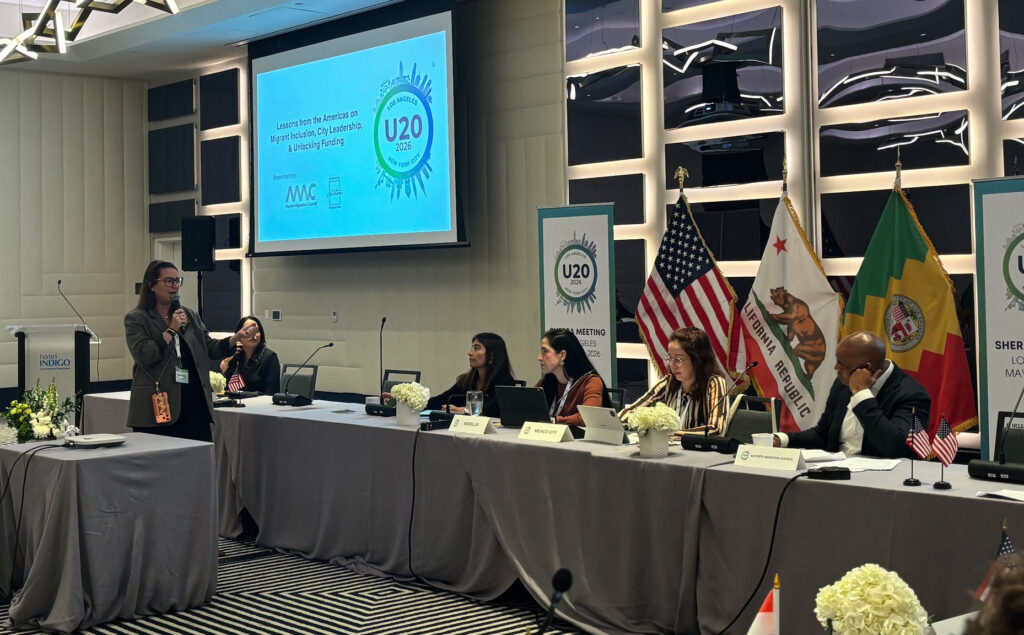
The session showed how cities have responded in various ways including by accessing the MMC Global Cities Fund (GCF), which channels financial and technical resources directly to city governments so mayors can address urgent needs while also building the case for sustained investment and lasting change. Specifically, leaders from Medellín, Colombia, and Mexico City, Mexico, shared with U20 peers from around the world the firsthand lessons they have learned about providing long-term support and inclusion for migrants and how cities can position themselves well to attract and effectively use international funding.
In the Americas, where countries are hosting more than 21.8 million forcibly displaced and stateless people, including nearly 7 million displaced Venezuelans living across the region, cities are providing emergency assistance daily. As they respond to the immediate needs of displaced people and families, they are also building systems for long-term support and inclusion of migrants, whose numbers have grown regionally from 14.3 million in 2020 to 17.5 million in 2024, an increase of 23 percent .
In Medellín, migrants make up 10 percent of the population, and migration is considered a structural urban reality. Through projects such as “Intégrate en los Territorios”; “Medellín Te Integra en Familia”; and the city’s MMC GCF project providing housing assistance for migrant and displaced families, Medellín has developed a comprehensive migration management model that combines emergency assistance with long-term reintegration pathways, psychosocial care, and territorial outreach. The model is based on four pillars: a public migration policy, a strategic implementation plan, strengthened international cooperation, and territorial service delivery focused on vulnerable communities. This facilitates an integrated support systems experience for migrants and newcomers, so they do not have to navigate multiple, complex processes to access the help they need; as well as targeted service delivery for specific groups, including women and children.
City representatives shared that they are working to reinforce legal frameworks to ensure the sustainability of services and policies that seek to integrate and support migrants. In Mexico City, for example, a new city constitution in 2017 enshrined the rights of migrants and ensured their access to services, empowering the Governor’s Office to continue serving all inhabitants regardless of political climate or future challenges. Medellín’s successes demonstrate that active engagement with civil society organizations is crucial.
As one city representative at the U20 gathering stated:
“Communities themselves must become part of the solution. Communities are not passive beneficiaries; they are active leaders in building solutions and social cohesion.”
City governments shared how they are adapting to the realities of international finance mechanisms. Mexico City’s Governor’s Office recently setup a Governmental Trust so that City Hall itself can receive international funding, improving efficiency and ensuring that the government can quickly route funds to service delivery on the ground. Cities are becoming more innovative, creating social and green bonds and new financial instruments like results-based funding.
Participants in the U20 session emphasized that effective program designs can also improve cities’ ability to attract and effectively use international funding. For instance, on International Migrants Day in December 2024, Mexico City’s administration created a new department to disperse assistance for wrap-around care for migrants and refugees. The city also redesigned the “Padrón de Huéspedes” system, comprising a change from a simple registration tool to integrated and comprehensive service provision for migrants which helped the dispersal of funds and resources, including by working across silos within the city authority. It required extensive work internally to understand the different funding and finance layers that are appropriate for different types of projects, but developments like this ensure the city is better positioned to receive the right funding and finance in the future.
Cities shared that pooled funding models also hold potential for scaling inclusion initiatives under the right conditions. In a pilot launching in July 2026 in Mexico City, a pioneering pooled fund will mobilize philanthropic capital, employer contributions, and multilateral bank resources to support migrant integration and economic inclusion in the city.
For regional banks like CAF, the Development Bank of Latin America and the Caribbean, telling the success stories of investing in migration-related initiatives is crucial. This helps grow investor confidence within the banks themselves and demonstrates how migration projects overlap with other areas of city investment such as housing, education and health. It is also clear that taking a tailored approach is vital – only with the acknowledgement that each city has different funding and financing needs, depending on how developed their work with migrants already is, can banks and city authorities work together to structure a specific investment pipeline for every city.
Around the U20 table, cities emphasized an openness to sharing experiences by offering insights and learning on different programs and financing mechanisms, as they all rapidly evolve to access resources and channel them to their residents. While cities innovate to meet the needs of migrants, refugees, returnees and welcoming communities, this recent global discussion offered a purposeful and encouraging step forward.
The session built on a strong foundation of collaboration between the Hilton Foundation and the MMC, as the two organizations work together to support cities in ensuring migrants and host communities both can thrive. And as U20 city representatives have returned to their respective city halls, 2026 co-host New York City takes on this year’s U20 leadership and prepares to welcome global mayors championing migrant inclusion to its own city in the fall.