
Millions of young people in Mexico are routinely labeled “Ninis” — “ni estudian ni trabajan” — which translates in English to “not in school not working.” The English equivalent is NEET: “Not in Education, Employment, or Training,” which was originally a technical measure to track youth outside of education and formal employment. In Mexico, “nini” has become a derogatory term for youth who are thought to be disengaged, apathetic, and unmotivated.

New research from our partners at Oxfam México paints a very different picture: Young people—particularly young women—dedicate long hours to unpaid care work in their homes and communities. This work keeps the economy running, yet it is rarely recognized or paid. The findings highlight an important barrier to young people’s participation in education, workforce training, employment, and ultimately their economic mobility. Understanding and addressing these barriers is critical to ensuring that pathways to employment are accessible to all young people, especially young women, – a priority for the Hilton Foundation.
Unpaid Care: A Major but Invisible Sector
Research shows that unpaid domestic and care work represents 23.9% of Mexico’s GDP, a larger share than manufacturing or commerce. If included in national accounts, domestic and care work would constitute Mexico’s largest productive sector. Women are the primary contributors; in 2024, they generated 2.7 times more economic value in these activities than men.
Yet this essential work remains largely unrecognized. Economic statistics prioritize paid work; therefore, young women caring for children, older adults, people with disabilities, and sick relatives are often described as “inactive” or “doing nothing.” In reality, they are working full-time without income, protection, or visibility. According to the report:
The label “nini” therefore misrepresents reality. Rather than describing a disengaged generation, it obscures the fact that young women sustain households and communities through unpaid labor.
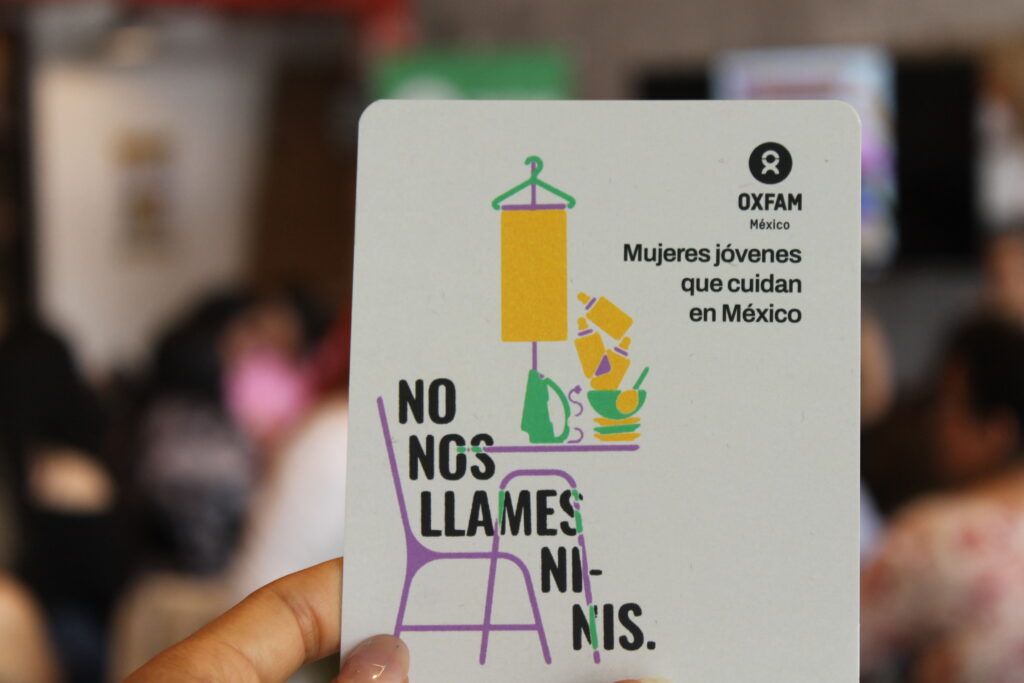
A participant at the launch event for Oxfam México’s report holds a card with the report name, “No Nos Llames Ni-Nis” (Oxfam México)
Time Poverty and Limited Choices
Young women in Mexico devote more than five hours on an average day to unpaid care—more than three times the time spent by young men. One in five young women performs a “triple burden” of household chores, direct care, and companionship. This group spends 7.6 hours per day, or 53.2 hours per week, on unpaid work, exceeding a full-time workweek.
This intense time poverty limits their ability to continue or return to education, access paid employment and fair wages, participate in public life, and invest in their own health and well-being. Life-course transitions intensify this pattern. In their mid-20’s, when many women begin living with a partner and having children, their hours of care work rise sharply. Meanwhile, men’s time devoted to care remains almost unchanged.
The report notes that young women aged 15 to 19 are a particularly invisible intergenerational support system, as they are typically not caring for their own children, but rather for people of different ages within their family networks. On average, they devote 3.8 hours a day to caring for siblings and other relatives as well as to household chores. This care subsidizes the economic system and their family members’ participation in the labor market at the expense of their own time and life plans.
A Closer Look at Mexico City:
Recognizing Barriers to Young Women’s Participation
The findings make clear that for a significant share of young women, the primary barrier is not a lack of motivation or talent, but unpaid caregiving and time poverty. The authors propose the following solutions:
Progress toward Recognizing Unpaid Care Work
Oxfam México and other advocates for young people have recently made important progress in recognizing unpaid care work in Mexico City, where the Congress has approved the Mexico City Care System Law. The new policy begins the process of creating a public system to recognize, redistribute, and reduce unpaid care work, with goals to expand services, infrastructure, and shared responsibility between the state, families, and the market. For young women, this can mean more time and opportunities to study, work, and care for their own lives and well-being.
Read Oxfam México’s report “No nos llames ‘ninis’” (“Don’t call us ‘ninis”)